This resource explores connections among executive functioning (EF) and geometry and spatial relations and provides tips for early childhood educators to support EF while engaging in and geometry and spatial
This fictionalized but very real story of actual teacher experiences tells the story of a team-teaching effort to incorporate meaningful and important concepts in geometry and spatial relations into a project-based
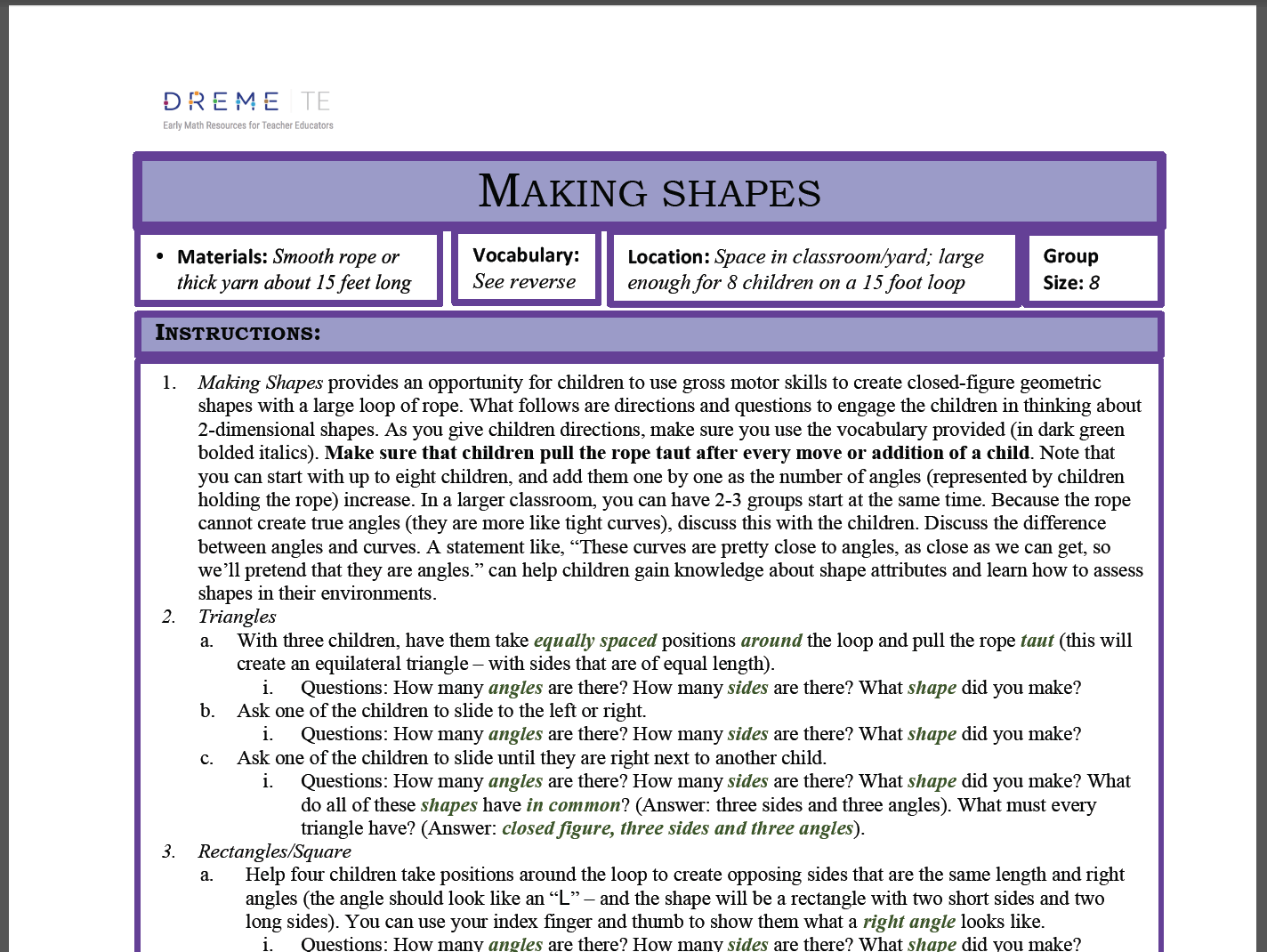
This activity provides participants with an opportunity to explore the attributes of 2-D geometric figures (similar to how one would engage children), and to explore their own beliefs and attitudes
The story of a preschool teacher leveraging children’s ideas to engage in geometry. It addresses anxiety teachers experience when working beyond simple shapes, offering a perspective that engages participants and the children they teach.
As a preservice teacher educator working with students who are just beginning their preschool teaching careers, I have three main goals: (1) to help students draw on their own experiences
Often in professional development settings it is productive to anchor the content of the day around one activity designed for children. Within the context of the activity, we can engage participants
Children often describe characteristics of shapes using their informal out-of-school language. We want to encourage participants to elicit children’s informal knowledge and language around the shapes and move them to being as specific
A short session around spatial relations can support moving beyond thinking about spatial relations as identifying the shapes, expanding their conceptualization of spatial relations and helping them see opportunities to support learning.